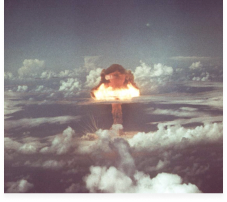
Decades of competition and mistrust have left the United States and Russia in possession of thousands of nuclear weapons. Can we work together to build a nuclear-free world?
The United States and Russia have been rivals since the end of World War II. Nuclear weapons have been at the heart of this competition since their invention, underlying every word and action exchanged between the two countries for the past seventy years.
Today, 93% of the world’s entire nuclear arsenal is in the possession of the United States and Russia.
Through the years, the two nations have built a combined 125,000 nuclear warheads. They’ve detonated thousands in weapons testing. On more than one occasion, they came dangerously close to using them to destroy each other. But there have also been periods of cooperation, working together for a safer world even in dangerous times.
Today, 93% of the world’s entire nuclear arsenal is in the possession of the United States and Russia. There is no path to a nuclear-free world without these two nations working together to reduce weapons stockpiles.

In 1945, the United States built the first nuclear weapon. Soon after, it became the first—and, to-date, only—nation to use two in warfare. Four years later, in 1949, the Soviet Union built its first nuclear bomb.
The period from the end of WWII to the end of the Soviet Union is known as the Cold War. The Cold War was the era of the Space Race, The Bay of Pigs, and the Cuban Missile Crisis. Both nations developed missiles that could carry nuclear warheads to the other’s territory. They backed opposing sides in regional conflicts around the world: the Korean War, the Vietnam War, and the Soviet invasion of Afghanistan. These proxy wars let them play out their aggressions on foreign turf, without risking a direct nuclear strike to their home nation.
The fear of nuclear war crept into every corner of American and Soviet life.
At the height of the Cold War, each nation had enough nuclear weapons to destroy the other many times over. For one nation to attack the other would mean the utter annihilation of both.
The game was Mutually Assured Destruction and both sides almost lost. A few times.
1983 was one of those times.
That year, President Reagan called the Soviet Union “the evil empire.” The Soviets were convinced—again—that the United States was planning a nuclear attack. U.S. military airplanes encouraged Soviet suspicions by flying right up to the edges of Soviet airspace, then turning back. One U.S. Navy exercise even simulated the bombing of an actual Soviet military site. In September of 1983, the Soviets mistook Korean Airlines Flight 007 for a U.S. spy plane and shot it down, killing all 269 passengers on board.
In the middle of this mounting tension, NATO’s annual military exercise—called Able Archer—was scheduled to take place. The 1983 exercise included new practices that the Soviets weren’t expecting. Among them: 19,000 US troops were flown to Europe on radio-silent flights, and NATO planes practiced new procedures for dropping nuclear weapons.
The Soviets panicked. The Kremlin put their air forces in East Germany and Poland on heightened alert.
Lieutenant General Leonard Perroots, a high-ranking American military intelligence officer stationed in Europe, learned of the Soviet reaction. He decided to ignore it. His decision may have prevented the event from escalating into World War III.
Diffusing the situation
A few years after the near-disaster of 1983 came an attempt at collaboration. In 1985, Mikhail Gorbachev became General Secretary of the U.S.S.R. Gorbachev, a reformer with a different agenda than his predecessors, started a correspondence with U.S. President Ronald Reagan. In 1986, the two agreed to sit down and discuss the nuclear situation.
They met in Reykjavik, Iceland. Reagan came to the table softened to the idea of cooperation by years of pressure from the Nuclear Freeze Movement at home. Gorbachev came with a proposal: rather than continuing to build weapons, the two nations should begin to reduce their arsenals.
The two men discussed the plan for hours over two long days. In the last session on the last day, they began negotiations to eliminate all nuclear weapons entirely.
But the two sides could not close the deal because of a disagreement about anti-ballistic missile systems. The U.S. had been pursuing technology to shoot down incoming missiles. They wanted to keep this technology as a sort of insurance policy—even if nuclear weapons were eliminated. The Soviet Union was worried that this technology would give the U.S. an advantage and wanted to eliminate it along with offensive nuclear weapons. The meeting snagged on this point and ended without an agreement.
Mutual success
Though unsuccessful, the summit in Iceland was a turning point. One year later, in 1987, Gorbachev and Reagan signed an agreement to completely eliminate all land-based short- and intermediate-range missiles. That meant both sides had to dismantle every nuclear and conventional missile that could reach distances of 500 to 5,500 kilometers (310 to 3,418 miles).
This first step led to more conversations and more treaties. Today the arsenals of the United States and Russia are less than one-quarter of what they were in 1986.
Chaos and Cooperation
By the end of 1991, the Soviet Union had dissolved into 15 independent states. Of those, four were in possession of nuclear weapons: Russia, Ukraine, Kazakhstan, and Belarus.
With the region in chaos, nervous eyes around the world were on Soviet stockpiles. In the upheaval, nuclear weapons could be sold or stolen, and panicked Soviet nuclear scientists—worried about their livelihood—might sell their knowledge to Iraq or Iran. The United States and Russia agreed that there should be only one nuclear successor to the Soviet Union: Russia.
From 1991 to 2012, the U.S. government contributed money to assist in securing and safely disposing of Russian nuclear materials. Annual assistance eventually reached $1 billion. By 1996, Ukraine, Kazakhstan, and Belarus had handed over their nuclear weapons to Russia.
In 1991, U.S. President George H. W. Bush and Gorbachev signed the Strategic Arms Reduction Treaty (START) to further limit nuclear arms. It expired and its replacement was signed in 2010 by U.S. President Barack Obama and Russian President Dmitry Medvedev. This deal, called New START, expires in 2021. In February of 2018, both the US and Russia met the deadline for dropping their number of strategic warheads to 1,550.
But the relationship between the United States and post-Soviet Russia has been rocky and inconsistent.
NATO—an alliance between North American and European countries originally created in opposition to the U.S.S.R—expanded in the 1990s. Several former Soviet republics and allies, including Latvia, Lithuania, Estonia, and Bulgaria, joined NATO. Some of these nations share a border with Russia, bringing NATO right up to their doorstep.
In December 2001, the George W. Bush administration gave six months notice of its intention to withdraw from the Anti-Ballistic Missile (ABM) treaty, which the United States and the Soviet Union had signed in 1972. The withdrawal took effect in June 2002, and the United States began deploying a national missile defense system. Their plans called for military sites in the Czech Republic, Poland, and Romania—too close for Russia’s comfort.
Then, in 2014, Russian troops invaded Crimea, a part of Ukraine with a large Russian-speaking minority. Russians ousted local leaders and replaced them with Russian sympathizers. The territory entered Russian federal control. The United States, European Union, and other world leaders were outraged and condemned the annexation.
Cooperation on nuclear arms reduction, which had seen decades of success, now seemed far-fetched.
After President Donald Trump was elected in 2016, he spoke on the phone with Russian President Vladimir Putin. When Putin asked about extending New START, Trump responded that it was a “bad deal” that unfairly favored Russia. Extending New START now looks unlikely, and there’s no plan to replace it.
Moving Forward
How do we move forward in cooperation with Russia?
How, especially now, when we have evidence that the Russian government interfered with the 2016 US presidential election? When we see Russia’s conduct in Ukraine? In Syria?
Reducing nuclear stockpiles is in the best interest of both nations. And history shows us that even when we’re at odds, we can work together on this issue.
So perhaps a better question is: what is to be gained if we do work with Russia to reduce the world’s nuclear arsenal?
History shows us that even when we’re at odds, we can work together on this issue.
The billions of dollars we spend annually to maintain our weapons of mass destruction could go to other needs, like relief from the effects of natural disasters.
Progress is essential, and progress is possible. If we could begin limiting our arsenals during the Cold War, we can continue to do so today. It’s up to us to hold our leaders to it.